

AnalysisWhen are German trains most punctual?
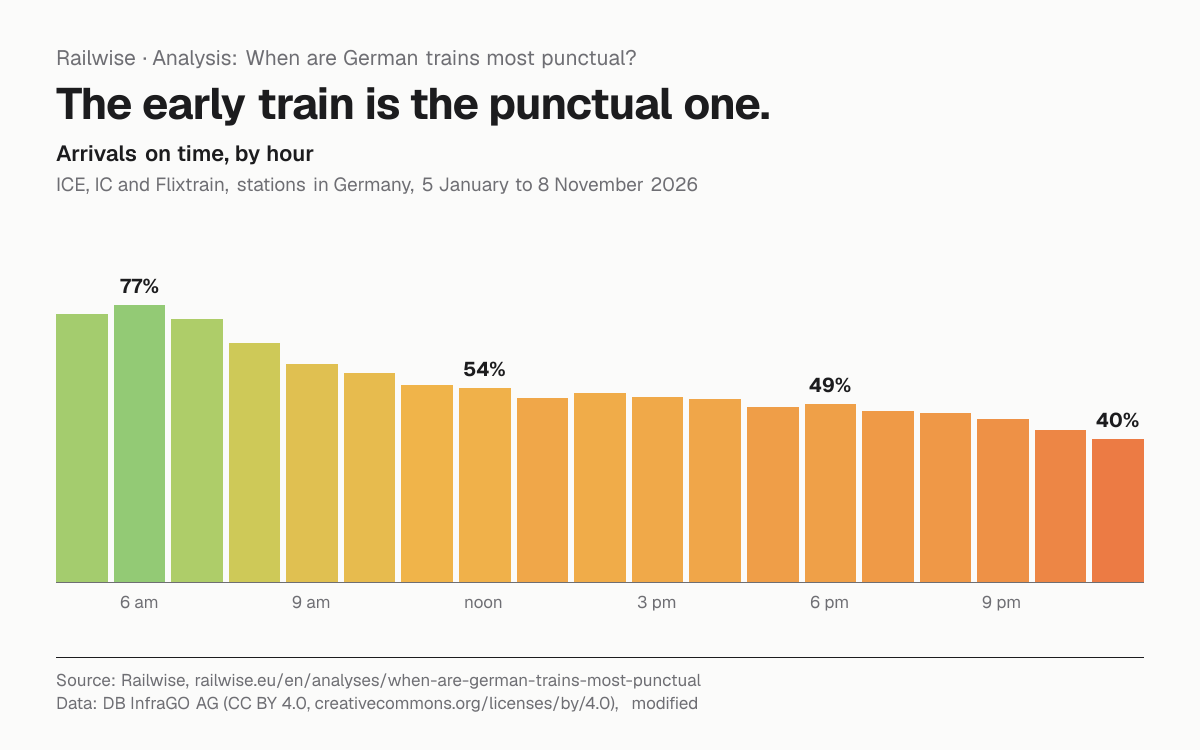
The early train is the punctual one.
In the morning, long-distance trains reach most of their stops on time; in the evening, fewer than half. And on every single day, the morning was more punctual than the evening.
Every stretch is coloured by how many arrivals at its ends were on time. The figures: 1,970,647 ICE, IC and Flixtrain arrivals at stations in Germany, 5 January to 8 November 2026. .
In short
- It pays to travel early.At 6 am, 77% of arrivals are on time; at 11 pm, 40%.
- Every day, the morning beat the evening.On all 307 days, the morning was more punctual than the evening: 72% against 45% on average.
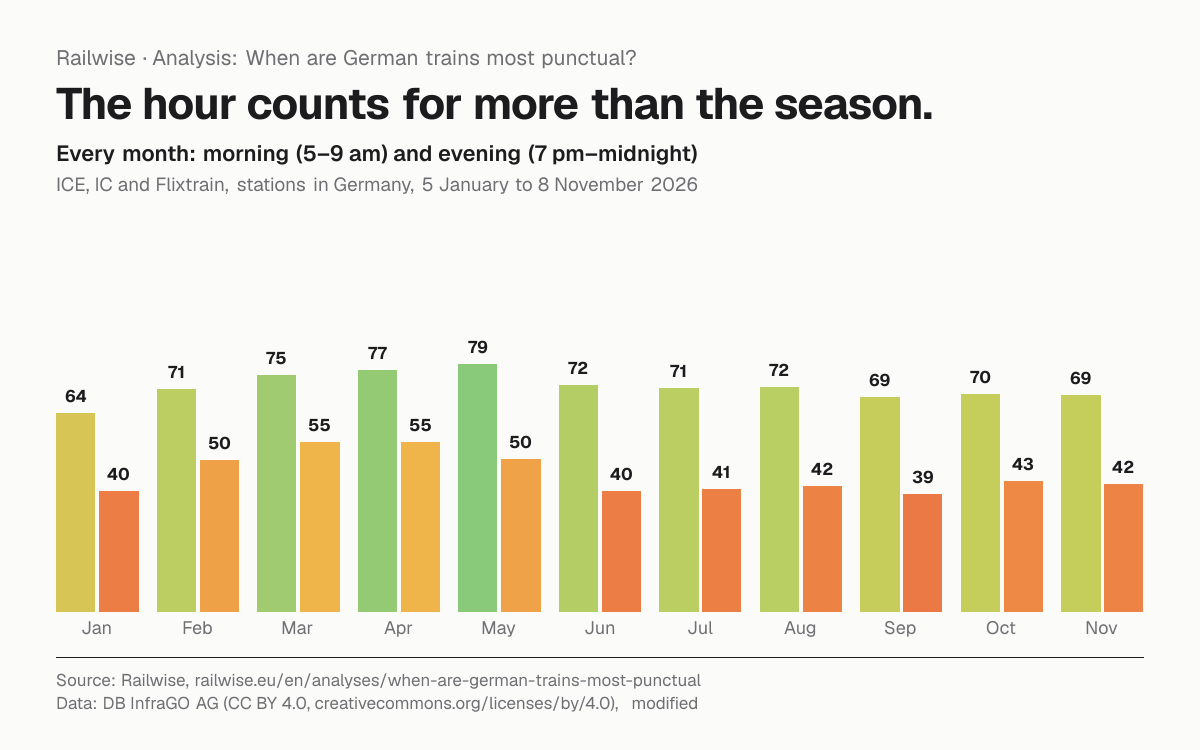
- The hour counts for more than the season.In the weakest month, 70% of arrivals were on time at 6 am; in the best month, 68% at most from 10 am.
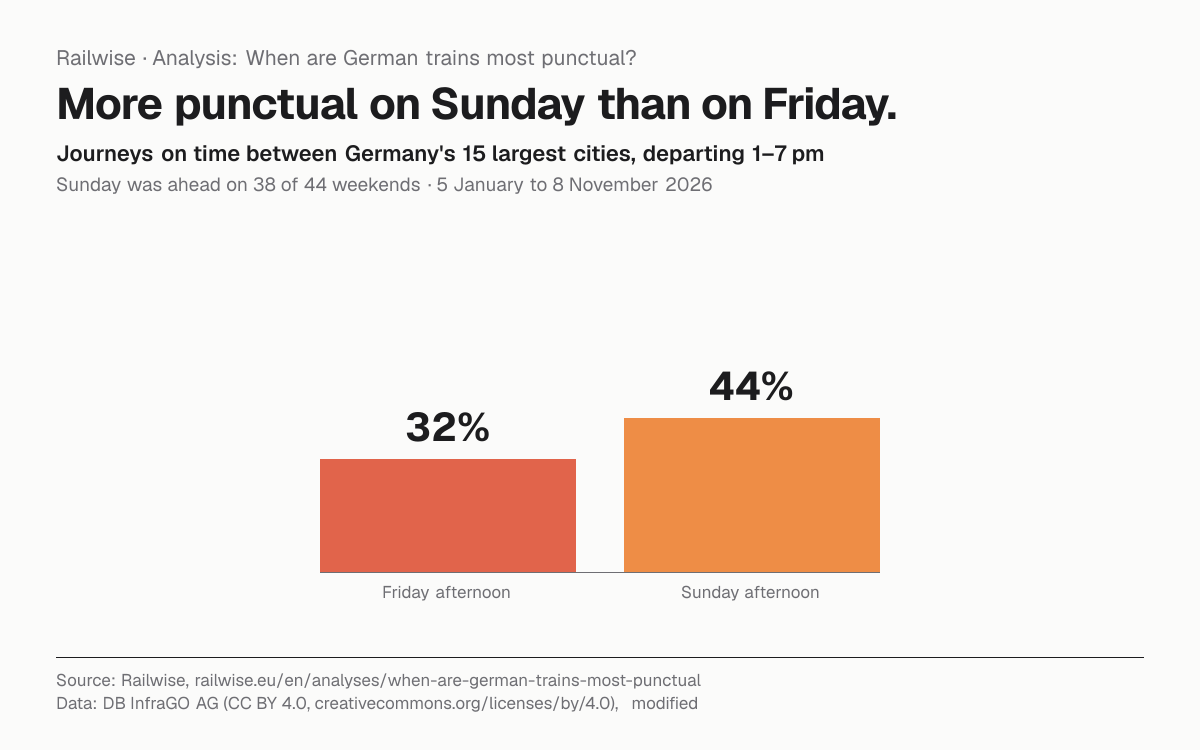
- Sundays are more punctual than Fridays.On Sundays, 62% of arrivals are on time; on Fridays, 50%. On Friday afternoons, 32% of direct journeys between the 15 largest cities arrived on time; on Sunday afternoons, 44%.
On time means less than 6 minutes late. 6.3% of arrivals were cancelled; they never count as on time.
Time of day
The day starts on time.
At 6 am, 77% of arrivals are on time. From there it gets a little worse almost every hour. By 11 pm, it's down to 40%.
More
We counted 1,970,647 ICE, IC and Flixtrain arrivals at stations in Germany with a known delay, by the hour of the scheduled arrival, on 308 days (44 full weeks). On time means less than 6 minutes late. 6.3% of arrivals were cancelled; they never count as on time and are shown separately. Overall, 54.2% of arrivals were on time.
Time of day
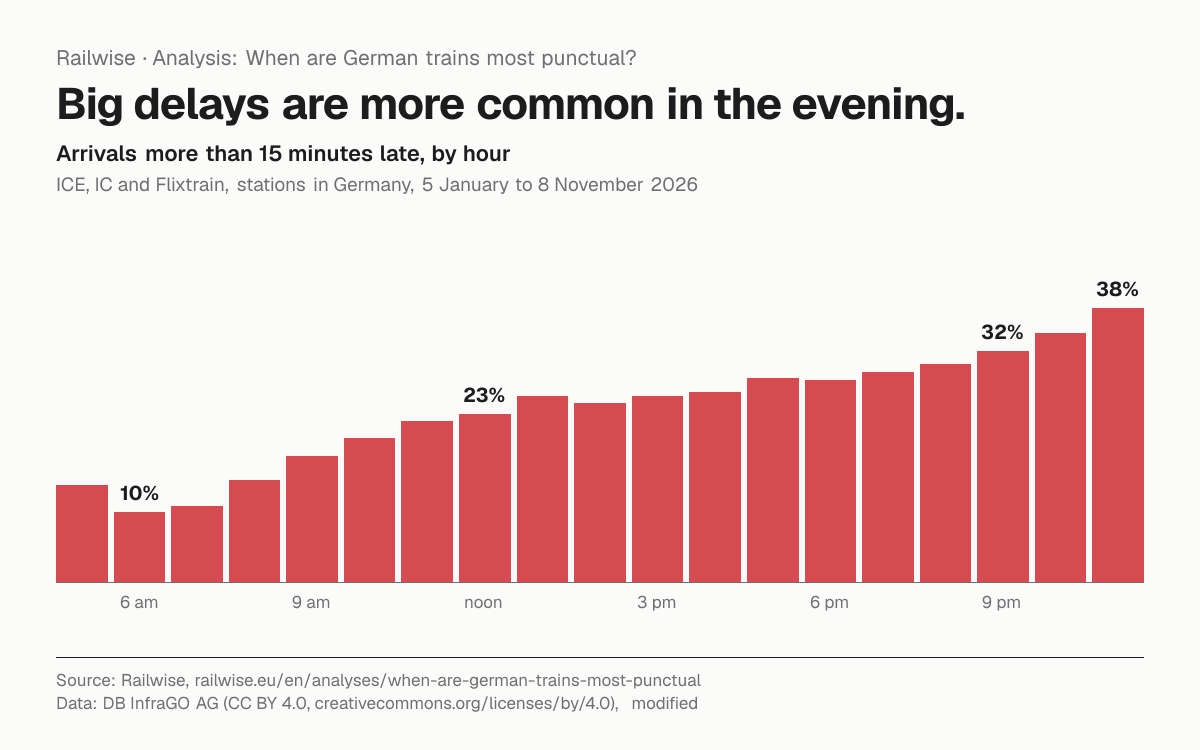
Big delays are more common in the evening.
At 6 am, 10% of arrivals are more than 15 minutes late. At 9 pm, it's 32%.
At 11 pm, it's 38%: almost as many as arrive on time (40%).
More
More than 15 minutes late means arriving 16 minutes or more behind schedule. Delays are reported in whole minutes; early arrivals count as on time. We counted arrivals at stations in Germany with a known delay, by the hour of the scheduled arrival. Cancellations are not part of this share and are shown separately: 5.9% of arrivals at 6 am were cancelled, 5.8% at 9 pm.
The same picture for whole journeys between Germany's 15 largest cities: in the afternoon (3–6 pm), journeys arrived on time less often than in the morning (5–8 am) on 173 of 183 connections (each direction counted separately), among connections with at least 30 journeys with a known delay in both windows. All journeys together, on time: 54.5% in the morning, 38.2% midday, 36.8% afternoon, 34.5% evening. More than 15 minutes late: 24.1%, 37.7%, 40.0%, 43.5%. Cancelled: 6.6%, 7.9%, 7.8%, 5.9%. These shares count whole journeys by departure time, not single arrivals by arrival time, and don't compare directly with the chart. A journey: board in one of Germany's 15 largest cities at the scheduled departure and get off in another, direct, without changing. A train counts once for every pair of cities it links directly. Every journey is measured against its own day's timetable, diversions and closures included.
Time of day
On time at the start, late anyway.
Most trains start on time, even in the late afternoon and evening: of the trains that start at 5 pm or later, 76% leave on time. But of all arrivals from 5 pm, only 47% are on time.
In the morning the gap is smaller: between 5 am and 7 am, 91% of trains start on time and 76% of arrivals are on time.
More
What we see: in the evening, trains start on time less often than in the morning, and arrivals are on time far less often. The gap between the two is wider in the evening than in the morning. We don't measure where a single delay comes from. The two figures don't count the same trains either: one line shows all trains that start in an hour, the other all arrivals in that hour, including those of trains that started earlier.
First station: the first stop of a run, when it is in Germany; 201,972 departures with a known delay, by the hour of the scheduled departure. Left on time means departing less than 6 minutes late. Many trains had run before, on the way back or under another number; our data does not link those runs. So we measure how punctually a train starts, not where its delay comes from. Arrived: all arrivals at stations in Germany in the same hours.
Time of day
Every single day, the morning beat the evening.
On all 307 days, the morning was more punctual than the evening. Over the whole period: 72% in the morning, 45% in the evening.
The closest day was 27 March: 67% against 64%.
More
Morning means a scheduled arrival from 5:00 to 8:59, evening from 19:00 to 23:59. We compare days with at least 300 arrivals with a known delay in both parts of the day: 307 of 308 days. The smallest gap on any day was 3.1 percentage points.
Day of the week
Sunday is the most punctual day.
On Sundays, 62% of arrivals are on time. On Thursdays and Fridays, 51% and 50%.
Saturdays come in at 59%. On working days, Monday is ahead, at 54%.
More
44 of each day of the week; public holidays are included and count on their day of the week. Cancellations: Mon 6.2%, Tue 6.3%, Wed 6.2%, Thu 6.2%, Fri 7.4%, Sat 6.3%, Sun 5.5%.
Day of the week
More punctual on Sunday than on Friday.
Leave after work on Friday and come back on Sunday, and you get two different afternoons. On Friday afternoons (1–7 pm), 32% of direct journeys between Germany's 15 largest cities arrived on time. On Sunday afternoons, 44%.
Of journeys departing on Friday morning (5–8 am), 51% arrived on time. Sunday afternoon was ahead of Friday afternoon on 38 of 44 weekends.
More
Afternoon here means departing 13:00 to 18:59. A journey: board in one of Germany's 15 largest cities at the scheduled departure and get off in another, direct, without changing. A train counts once for every pair of cities it links directly. Every journey is measured against its own day's timetable, diversions and closures included. Journeys don't compare directly with the per-stop arrivals in the other charts. Cancelled: 9.6% of journeys on Fridays, 6.6% on Sundays. On a typical connection (median over 185 connections, each direction counted separately, with at least 30 journeys on Friday and on Sunday afternoons), 30.3% arrived on time on Fridays and 41.9% on Sundays; Sunday was more punctual on 183 of 185. Weekends on which Friday was ahead (date of the Friday): 9 Jan, 27 Mar, 3 Apr, 1 May, 15 May, 5 Jun.
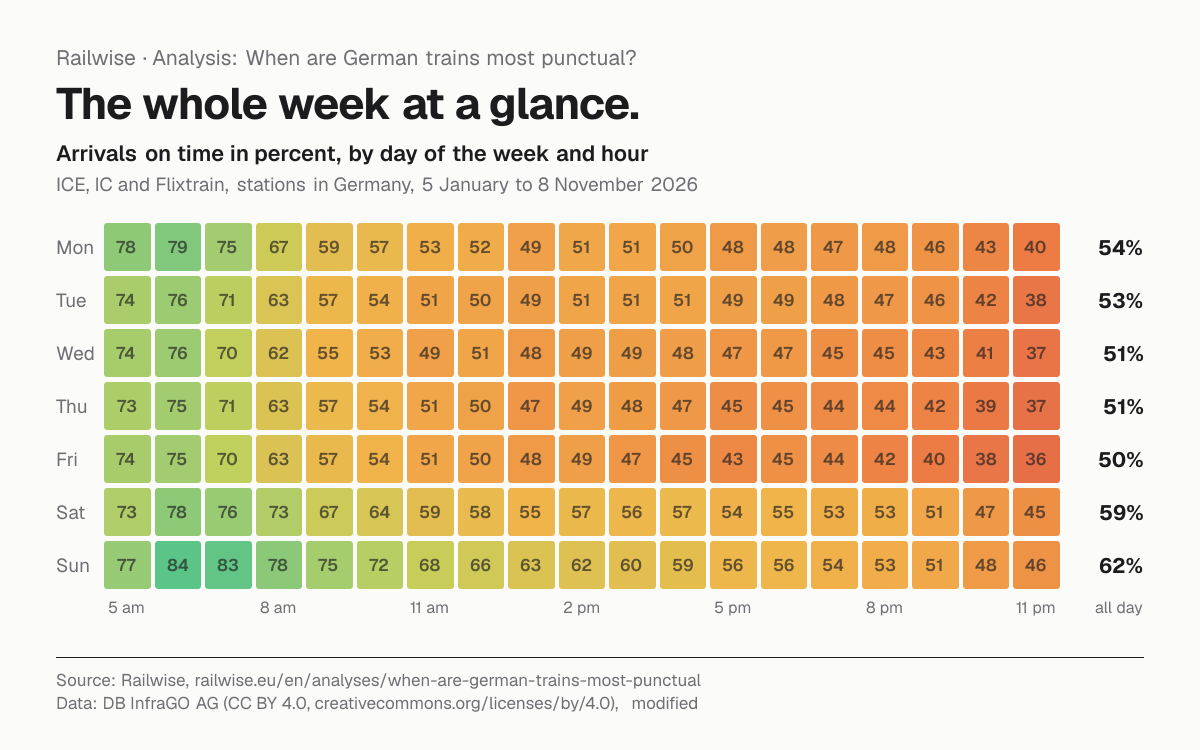
The whole week at a glance.
Every day of the week, hour by hour. The best time is Sunday at 6 am: 84% of arrivals are on time. The worst is Friday at 11 pm: 36%.
| Hour | 5 am | 6 am | 7 am | 8 am | 9 am | 10 am | 11 am | noon | 1 pm | 2 pm | 3 pm | 4 pm | 5 pm | 6 pm | 7 pm | 8 pm | 9 pm | 10 pm | 11 pm | all day |
|---|---|---|---|---|---|---|---|---|---|---|---|---|---|---|---|---|---|---|---|---|
| Monday | 78 | 79 | 75 | 67 | 59 | 57 | 53 | 52 | 49 | 51 | 51 | 50 | 48 | 48 | 47 | 48 | 46 | 43 | 40 | 54% |
| Tuesday | 74 | 76 | 71 | 63 | 57 | 54 | 51 | 50 | 49 | 51 | 51 | 51 | 49 | 49 | 48 | 47 | 46 | 42 | 38 | 53% |
| Wednesday | 74 | 76 | 70 | 62 | 55 | 53 | 49 | 51 | 48 | 49 | 49 | 48 | 47 | 47 | 45 | 45 | 43 | 41 | 37 | 51% |
| Thursday | 73 | 75 | 71 | 63 | 57 | 54 | 51 | 50 | 47 | 49 | 48 | 47 | 45 | 45 | 44 | 44 | 42 | 39 | 37 | 51% |
| Friday | 74 | 75 | 70 | 63 | 57 | 54 | 51 | 50 | 48 | 49 | 47 | 45 | 43 | 45 | 44 | 42 | 40 | 38 | 36 | 50% |
| Saturday | 73 | 78 | 76 | 73 | 67 | 64 | 59 | 58 | 55 | 57 | 56 | 57 | 54 | 55 | 53 | 53 | 51 | 47 | 45 | 59% |
| Sunday | 77 | 84 | 83 | 78 | 75 | 72 | 68 | 66 | 63 | 62 | 60 | 59 | 56 | 56 | 54 | 53 | 51 | 48 | 46 | 62% |
| Hour | Monday | Tuesday | Wednesday | Thursday | Friday | Saturday | Sunday |
|---|---|---|---|---|---|---|---|
| 5 am | 78 | 74 | 74 | 73 | 74 | 73 | 77 |
| 6 am | 79 | 76 | 76 | 75 | 75 | 78 | 84 |
| 7 am | 75 | 71 | 70 | 71 | 70 | 76 | 83 |
| 8 am | 67 | 63 | 62 | 63 | 63 | 73 | 78 |
| 9 am | 59 | 57 | 55 | 57 | 57 | 67 | 75 |
| 10 am | 57 | 54 | 53 | 54 | 54 | 64 | 72 |
| 11 am | 53 | 51 | 49 | 51 | 51 | 59 | 68 |
| noon | 52 | 50 | 51 | 50 | 50 | 58 | 66 |
| 1 pm | 49 | 49 | 48 | 47 | 48 | 55 | 63 |
| 2 pm | 51 | 51 | 49 | 49 | 49 | 57 | 62 |
| 3 pm | 51 | 51 | 49 | 48 | 47 | 56 | 60 |
| 4 pm | 50 | 51 | 48 | 47 | 45 | 57 | 59 |
| 5 pm | 48 | 49 | 47 | 45 | 43 | 54 | 56 |
| 6 pm | 48 | 49 | 47 | 45 | 45 | 55 | 56 |
| 7 pm | 47 | 48 | 45 | 44 | 44 | 53 | 54 |
| 8 pm | 48 | 47 | 45 | 44 | 42 | 53 | 53 |
| 9 pm | 46 | 46 | 43 | 42 | 40 | 51 | 51 |
| 10 pm | 43 | 42 | 41 | 39 | 38 | 47 | 48 |
| 11 pm | 40 | 38 | 37 | 37 | 36 | 45 | 46 |
| all day | 54% | 53% | 51% | 51% | 50% | 59% | 62% |
More
How to read it: find the day of the week and the hour of the scheduled arrival. The figure is the share of arrivals on time, in percent.
We count arrivals at stations in Germany by the hour of the scheduled arrival; "5 am" means 5:00 to 5:59. The day of the week is the train's service day: when a train that started on Sunday evening arrives early on Monday, the arrival counts for Sunday. Every cell rests on at least 3,338 arrivals with a known delay from 44 days. Before 5 am, too few trains run for reliable figures for each day of the week. All figures are in the CSV file too.
The hour counts for more than the season.
April was the most punctual month (62%), January the weakest (48%). But even in January, more arrivals were on time at 6 am (70%) than at any hour from 10 am in April (68% at most).
More
Per day and per month: all arrivals at stations in Germany with a known delay. January counts from 5 January, November to 8 November; the best and the weakest month are taken from months with at least 27 days. On time by month: Jan 48%, Feb 57%, Mar 62%, Apr 62%, May 59%, Jun 50%, Jul 50%, Aug 51%, Sep 49%, Oct 53%, Nov 53%. Cancelled by month: Jan 14.6%, Feb 7.1%, Mar 4.5%, Apr 3.9%, May 3.8%, Jun 6.8%, Jul 6.3%, Aug 6.6%, Sep 6.0%, Oct 4.3%, Nov 4.7%. On the worst day, 26 January, 25% of arrivals were cancelled. We don't measure why a day or a month went worse.
And on your route?
Pick your start and destination from Germany's 15 largest cities. You'll see at which time of day trains on your route arrived on time most often.
On this route, journeys arrived on time most often in the early morning (52%) and least often in the evening (36%).
Early5–8 am52% on time
28% more than 15 min late6.2% cancelled · 919 journeys
28% more than 15 min late6.2% cancelled919 JourneysMidday11 am–2 pm42% on time
33% more than 15 min late8.0% cancelled · 1,235 journeys
33% more than 15 min late8.0% cancelled1,235 JourneysAfternoon3–6 pm45% on time
34% more than 15 min late9.3% cancelled · 1,701 journeys
34% more than 15 min late9.3% cancelled1,701 JourneysEvening7–10 pm36% on time
45% more than 15 min late6.5% cancelled · 1,389 journeys
45% more than 15 min late6.5% cancelled1,389 Journeys
The line marks all connections between Germany's 15 largest cities together, for comparison. Figures from 30 journeys with a known delay per departure time.
More
A journey: board in one of Germany's 15 largest cities at the scheduled departure and get off in another, direct, without changing. A train counts once for every pair of cities it links directly. Every journey is measured against its own day's timetable, diversions and closures included. We count by scheduled departure: early 5:00 to 7:59, midday 11:00 to 13:59, afternoon 15:00 to 17:59, evening 19:00 to 21:59. On time means arriving at the destination less than 6 minutes late; more than 15 minutes late means 16 minutes or more. A journey is cancelled when the departure at the start or the arrival at the destination was cancelled; it never counts as on time. We show figures from 30 journeys with a known delay per departure time; with few journeys, times of day can also differ by chance.
Use the figures and charts
You're free to use every figure and chart in this analysis, including in your own reporting. All we ask is a credit.
- Credit
Source: Railwise (own measurement, data DB InfraGO, CC BY 4.0), railwise.eu/en/analyses/when-are-german-trains-most-punctual
- ChartsPNG, credit in the image
- Data
All figures as CSVVersion 1, German column names
- Licence
Data: “Timetables” (IRIS) by DB InfraGO AG, licensed under CC BY 4.0. Collected, cleaned and aggregated by Railwise into its own figures (modified). Not an analysis or statement by Deutsche Bahn. Method and corrections. Figures and charts of this analysis: CC BY 4.0, credit "Railwise (railwise.eu)".
- Questions
- Patrick Trepte, patrick@railwise.eu
- Justin Räker, justin@railwise.eu
Figures for a particular route, region or station: press page
How we counted
The terms
- On time
- Arriving less than 6 minutes late (up to 5:59, as Deutsche Bahn counts). When the delay is unknown, the arrival counts as neither on time nor late.
- Cancelled
- For stops: nobody could get off at the station. For journeys: the departure at the start or the arrival at the destination was cancelled. Cancellations never count as on time; their share is given under “More” and in the CSV file.
- Stops and journeys
- Time of day, day of the week, the week table and the year count arrivals at every station in Germany (stops). Friday/Sunday and your route count journeys between Germany's 15 largest cities: board, ride direct, get off; a train counts once for every pair of cities it links directly. One chart counts differently: "left on time" counts departures at a train's first station.
- More than 15 minutes late
- Arriving 16 minutes or more behind schedule. Delays are reported in whole minutes; cancellations are not included and are shown separately.
Data and period
Data: “Timetables” (IRIS) by DB InfraGO AG, licensed under CC BY 4.0. Collected, cleaned and aggregated by Railwise into its own figures (modified). Not an analysis or statement by Deutsche Bahn. Method and corrections.
Period: service days 5 January to 8 November 2026, 44 full weeks, so every day of the week counts equally often. ICE, IC and Flixtrain; stations in Germany only (Basel Bad Bf counts as abroad). 258,187 train runs, 2,117,707 planned arrivals; the outcome is known for 99.3%. Trains listed twice (one train under two numbers) count once; stops without boarding or alighting don't count. Times are scheduled, in German time; delays are whole minutes. For 1 April, only data from the afternoon on is available; the day counts in the totals but not in the comparison of single days. On 7 more days, single hours are missing (13 March, 18 March, 11 April, 15 April, 16 April, 18 April, 25 April); they count everywhere, but not as the best or the worst day.
Germany's 15 largest cities, each by its main station: Berlin, Hamburg, Munich, Cologne, Frankfurt, Düsseldorf, Stuttgart, Leipzig, Dortmund, Bremen, Essen, Dresden, Nuremberg, Hanover, Duisburg.
Version, corrections and independence
Version 1, as of 10 November 2026. A cited figure never changes silently: every correction is listed with its date, old and new value in the corrections log (none so far). Railwise is independent and not affiliated with Deutsche Bahn.